Monday, December 17, 2012
School on Friday
We shouldn't go to school on Friday because it is only a half day, and the world is going to end! The Mayans predicted it a long time ago and they had the best measuring rocks around so it must be true! It's set in stone! We need to enjoy our last day.

Monday, November 5, 2012
PrObama
Election day is tomorrow! Many undecided voters are not sure who they will be voting for. Obama? Romney? Perhaps even Stein, Johnson, or Goode? I am here to change you from an undecided voter, to an informed voter. There are many reasons why you should vote for Obama, but here are some examples of one major one, foreign policy.

Disclaimer: This essay does not represent my political views. This is a persuasive essay for my english class, written on a candidate chosen by an online quiz asking about my views on certain topics.
First, during Obama’s first presidential campaign in 2008, he promised that if he was elected, he would end the war in Iraq, and bring our troops home, reconnecting families. Obama kept this promise and ended the war in Iraq on December 15, 2011. He is now bringing troops home, bringing families together, bringing happiness back to children, and bringing relief to worried relatives.
Do you remember what happened on September 11, 2001? When 3,000 innocent American lives were lost when airplanes cascaded from the sky colliding into The World Trade Center and causing it’s collapse. Do you remember the instant sense of shock, disbelief, and fear? Do you remember who the cause of this pain was? That’s right, terrorists. Obama, in just 4 years of being in office, managed to not only locate the leader of the most feared terrorist organization in the world, but he also took him out. With Osama Bin Laden dead, al-Qaeda has been catapulted back so many steps that an Olympic athlete would even hesitate traveling that far.
I could give you a bunch more facts, but I am just going to share two more things, both are quotes from the final presidential debate, 2012.
In the final debate, both candidates started off really strong, both living up to their reputations as master debaters, but after Obama made a few certain comments to Romney involving Russia and our navy, Romney got all clammed up and nervous, losing his usual finesse in debates. Here are the clever comments shared with us by Obama. Not only is he smart, but he can make us laugh.
“Governor Romney, I'm glad that you recognize that Al Qaida is a threat, because a few months ago when you were asked what's the biggest geopolitical threat facing America, you said Russia, not Al Qaida; you said Russia, in the 1980s, they're now calling to ask for their foreign policy back because, you know, the Cold War's been over for 20 years.”
Now that single quote shows you how much better Obama’s understanding is of foreign policy, and how much quicker he is able to think on his feet to prove a point.
If you enjoyed that quote, here is another by Obama after Romney says that our navy is the smallest it has been since 1916, we only have 285 ships, Romney will make sure we have enough to do missions properly. This is how Obama responded:
“But I think Governor Romney maybe hasn't spent enough time looking at how our military works. You mentioned the Navy, for example, and that we have fewer ships than we did in 1916. Well, Governor, we also have fewer horses and bayonets, because the nature of our military's changed. We have these things called aircraft carriers, where planes land on them. We have these ships that go underwater, nuclear submarines.”
A vote for Obama, is a vote for reuniting families, and keeping our country safe. PrObama, 2013.
Thursday, October 25, 2012
War Child: A Child Soldier's Story
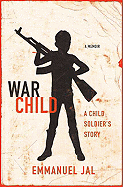 War Child by Emmanuel Jal is an autobiography about Jal’s search for education and a better life in a time of war. In the 1980’s, the Islamic government of Sudan, based in Khartoum, was seizing tribal land for it’s resources, especially oil. The arab government soldiers and black muslims, murahleen, became one in Jal’s mind, jallabas. Jallabas were ruthless in their venture for wealth. They would kill everyone, men, women, and children, without hesitation or a moments remorse. They would burn down villages, some with the the village people still inside, rape women, and abduct the boys and oppress them into slavery. These actions infuriated the sudanese non-muslims. They retaliated. Tribes that had been fighting each other on and off for centuries joined together to create the Sudan People’s Liberation Army, or SPLA. The SPLA with their AK-47s fought the government soldiers with G3s and the murahleen with Mack 4s.
Jal’s father, Babba, joined the SPLA and eventually rose to the rank of Commander. During this time though, Jal’s family faced many hardships as they were forced to run from village to village doing their best to avoid the wake of destruction caused by the jallabas. Jal and his family remained intact for awhile, but it did end. After Jal’s mother was killed, him and his family were taken to a SPLA base in Luaal where they were safe. Shortly after they arrived, a soldier, sent from Babba, approached Jal and told him it was time he went to Ethiopia and got an education. Jal agreed to go, leaving his family behind, hoping to see them again.
Little did Jal know was that the “education” in Ethiopia was him sitting in a refugee camp watching kids die every day from starvation and disease. Jal ended up joining the SPLA while at this camp and became a Jesh a Mer, child soldier. Jal’s hate for jallabas grew as he witnessed the ugliness of war. So many people died and the fighting just never ended, the SPLA even split into two separate factions causing even more death. A woman named Emma finally took Jal away from the war, to Kenya, where he could receive a proper education.
After struggling through school after school, Jal got an education, not a complete one, but something he could work with. He formed an organization called Cassy which helped fund the education of other boys effected by the war in Sudan. Not being able to raise enough money for Cassy by himself, Jal turned to music to help fund it. After years of, “Who are you?” and, “You guys suck,” Jal made it. Today, Emmanuel Jal is one of the most popular Hip-Hop/Rap stars in Africa, and has inspired many with his Christian lyrics of freedom and forgiveness.
This book was released shortly after a documentary was made about his life, soon after the war had ended. The war in Sudan was all over the news and there weren’t many first person accounts of what happened because Sudan was so dangerous for outsiders. Jal’s novel and documentary gave people what they wanted, a view straight into the war from an interesting view, a child soldier. He wrote this book for teenagers and adults around the world to raise awareness of struggles in Africa and hopefully raise funds to help support Cassy. He wants us to who can to help those who need it in anyway possible. He is inspiring us to make a change and hopefully prevent the tragedies that happened to him from happening to others.
Throughout the novel Jal keeps us on our toes by switching between english words and the words he knew growing up. Here is an example, “Even our skin crawled with lice, and the worst were chiggers - mites that burrowed into our skin and laid their eggs” (Jal 59). White people were known as khawajas, houses were tukuls, and airplanes were nyanking. He constantly used these words over their english equivalents to give us a better connection to his culture. Jal uses a lot of imagery through out his book, you are seeing exactly what he is seeing. I would give you an example but reminding you that it is a war book, I have decided to let you eat food later instead.
I give War Child 4.2 AK-47s
Here is my rating system:
1 AK-47: Couldn’t finish it...
2 AK-47: Finished it, with a few naps in between chapters.
3 AK-47: I read it, it was good but nothing special.
4 AK-47: A good book, I would recommend it to everyone.
5 AK-47: I could not put the book down! I couldn’t do anything until I finished this book.
Monday, September 24, 2012
One of My Favorites
One of my favorite novels is Murder on The Orient Express written by The Queen of Mystery, Agatha Christie. The plot unfolds as Hercule Poirot, a brilliant detective from Scotland Yard, boards a train called the Orient Express. On this luxurious locomotive one of the passengers was murdered in the night. Thankfully for the passengers, Mr. Poirot was onboard, who closes cases faster than a bullet train from Boston to New York.
Unfortunately for the killer, the train’s voyage was halted by a horrendous blizzard that stopped it in it’s tracks. This gave Mr. Poirot all the time he needed to solve the murder.
Poirot started by interviewing all the passengers and employees, then he followed leads from the interviews for further investigation. As Poirot dug deeper, he found the case to be highly improbable. Everyone had an alibi for the night in question confirmed by another passenger. How could this have been done? Poirot ruminated about the murder for a prolonged time, and then abruptly he had an epiphany.
Why is the train completely full during this time of year? When almost no one is traveling.
How can such a variety of people ever come together in one place? An american assistant, british newly weds, an italian business man, a swedish maid, a russian princess, and many more.
The answer... it was all planned! In the past all of the passengers, excluding Poirot and his dear friend Mr. Bouc, who runs the train, had been involved in a murder case. The man who was murdered, Mr. Ratchett, was actually called Cassetti, a man who kidnapped and murdered a little girl named Daisy Armstrong, and got away with it. The rest of the passengers, and the wagon-lit conductor, worked for the Armstrongs or were family. They were appalled when Cassetti was declared innocent and free of all charges. They took it upon themselves to be the swift hand of justice, so they carefully planned out Cassetti’s murder.
Poirot realized all of this, revealed it to everyone, and then did something he has never done before. He let them all go because he realized through this ordeal who the “victim” truly was and the motives behind his death.
This novel is one of my favorites because it amazes me how Poirot deciphers these mysteries. He always starts with the basics, and pursues leads that others couldn’t surmise. When confronted by an extremely arduous task he remains calm, and utilizes his astonishing problem solving skills to discover the solution. I am inspired by this character to reinforce and enhance my own problem solving ability so that I can be more successful in future endeavors.
Another reason I loved this novel was because it feeds our own common biases. For example, The italian business man was the first suspect in the crime because many people accept italian stereotypes namely that they are fond of violence and unforgiving. Another bias in this book is fulfilled by the arrogant, haughty, condescending russian princess, who justifies most stereotypical behaviors of both princesses and russians.
Lastly, this book granted me with an increased understanding of the world around me. I learned that two wrongs do not make a right, but three rights make a left. To explain, when acts or people are viewed upon we all instantly form biases about them. If we take the time to inspect these acts and people more thoroughly, we can realize that maybe these acts are justified, or that these people are superior to our previous stereotypes. To summarize, “Don’t judge a book by it’s cover,” or in other words, don’t judge someone or something superficially or prematurely.
I learned that strong writing consists of not only great ideas, but creating clear reference points and contextual visualization for the reader. It puts the reader in the moment and allows them to identify with the story. Good writing is when the reader cannot put the book down. When they need to keep reading. When they want to continue the experience.
Subscribe to:
Posts (Atom)