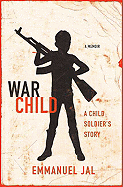
 War Child by Emmanuel Jal is an autobiography about Jal’s search for education and a better life in a time of war. In the 1980’s, the Islamic government of Sudan, based in Khartoum, was seizing tribal land for it’s resources, especially oil. The arab government soldiers and black muslims, murahleen, became one in Jal’s mind, jallabas. Jallabas were ruthless in their venture for wealth. They would kill everyone, men, women, and children, without hesitation or a moments remorse. They would burn down villages, some with the the village people still inside, rape women, and abduct the boys and oppress them into slavery. These actions infuriated the sudanese non-muslims. They retaliated. Tribes that had been fighting each other on and off for centuries joined together to create the Sudan People’s Liberation Army, or SPLA. The SPLA with their AK-47s fought the government soldiers with G3s and the murahleen with Mack 4s.
Jal’s father, Babba, joined the SPLA and eventually rose to the rank of Commander. During this time though, Jal’s family faced many hardships as they were forced to run from village to village doing their best to avoid the wake of destruction caused by the jallabas. Jal and his family remained intact for awhile, but it did end. After Jal’s mother was killed, him and his family were taken to a SPLA base in Luaal where they were safe. Shortly after they arrived, a soldier, sent from Babba, approached Jal and told him it was time he went to Ethiopia and got an education. Jal agreed to go, leaving his family behind, hoping to see them again.
Little did Jal know was that the “education” in Ethiopia was him sitting in a refugee camp watching kids die every day from starvation and disease. Jal ended up joining the SPLA while at this camp and became a Jesh a Mer, child soldier. Jal’s hate for jallabas grew as he witnessed the ugliness of war. So many people died and the fighting just never ended, the SPLA even split into two separate factions causing even more death. A woman named Emma finally took Jal away from the war, to Kenya, where he could receive a proper education.
After struggling through school after school, Jal got an education, not a complete one, but something he could work with. He formed an organization called Cassy which helped fund the education of other boys effected by the war in Sudan. Not being able to raise enough money for Cassy by himself, Jal turned to music to help fund it. After years of, “Who are you?” and, “You guys suck,” Jal made it. Today, Emmanuel Jal is one of the most popular Hip-Hop/Rap stars in Africa, and has inspired many with his Christian lyrics of freedom and forgiveness.
This book was released shortly after a documentary was made about his life, soon after the war had ended. The war in Sudan was all over the news and there weren’t many first person accounts of what happened because Sudan was so dangerous for outsiders. Jal’s novel and documentary gave people what they wanted, a view straight into the war from an interesting view, a child soldier. He wrote this book for teenagers and adults around the world to raise awareness of struggles in Africa and hopefully raise funds to help support Cassy. He wants us to who can to help those who need it in anyway possible. He is inspiring us to make a change and hopefully prevent the tragedies that happened to him from happening to others.
Throughout the novel Jal keeps us on our toes by switching between english words and the words he knew growing up. Here is an example, “Even our skin crawled with lice, and the worst were chiggers - mites that burrowed into our skin and laid their eggs” (Jal 59). White people were known as khawajas, houses were tukuls, and airplanes were nyanking. He constantly used these words over their english equivalents to give us a better connection to his culture. Jal uses a lot of imagery through out his book, you are seeing exactly what he is seeing. I would give you an example but reminding you that it is a war book, I have decided to let you eat food later instead.
I give War Child 4.2 AK-47s
Here is my rating system:
1 AK-47: Couldn’t finish it...
2 AK-47: Finished it, with a few naps in between chapters.
3 AK-47: I read it, it was good but nothing special.
4 AK-47: A good book, I would recommend it to everyone.
5 AK-47: I could not put the book down! I couldn’t do anything until I finished this book.
